




Philippine workers working while unwell is now a measurable business problem. The TELUS Mental Health Index found that 82 percent of workers in the Philippines work while mentally or physically unwell at least one day a week. TELUS Health published the findings on November 10, 2026. Moreover, 55 percent say their mental health hurts their productivity.
Key numbers from the report
- 55 percent say mental health negatively affects productivity at work
- 48 percent often end the workday mentally or physically exhausted
- 82 percent work while unwell at least one day a week
- 77 percent fear limited career options if their workplace knew of a mental health issue
Exhaustion and presenteeism carry a cost
Workers who often end the day exhausted record an estimated annual productivity loss of 49.5 working days. By comparison, workers who do not report exhaustion lose 29.7 days. These estimates include time off and reduced effectiveness while working, based on a 240-day working year.
Presenteeism means reduced productivity while working unwell. Workers who never work while unwell lose an estimated 17.3 days a year. In contrast, those working unwell four or five days a week lose 64.1 to 71.1 days. Therefore, employers need to look beyond attendance.
Money worries add to the strain
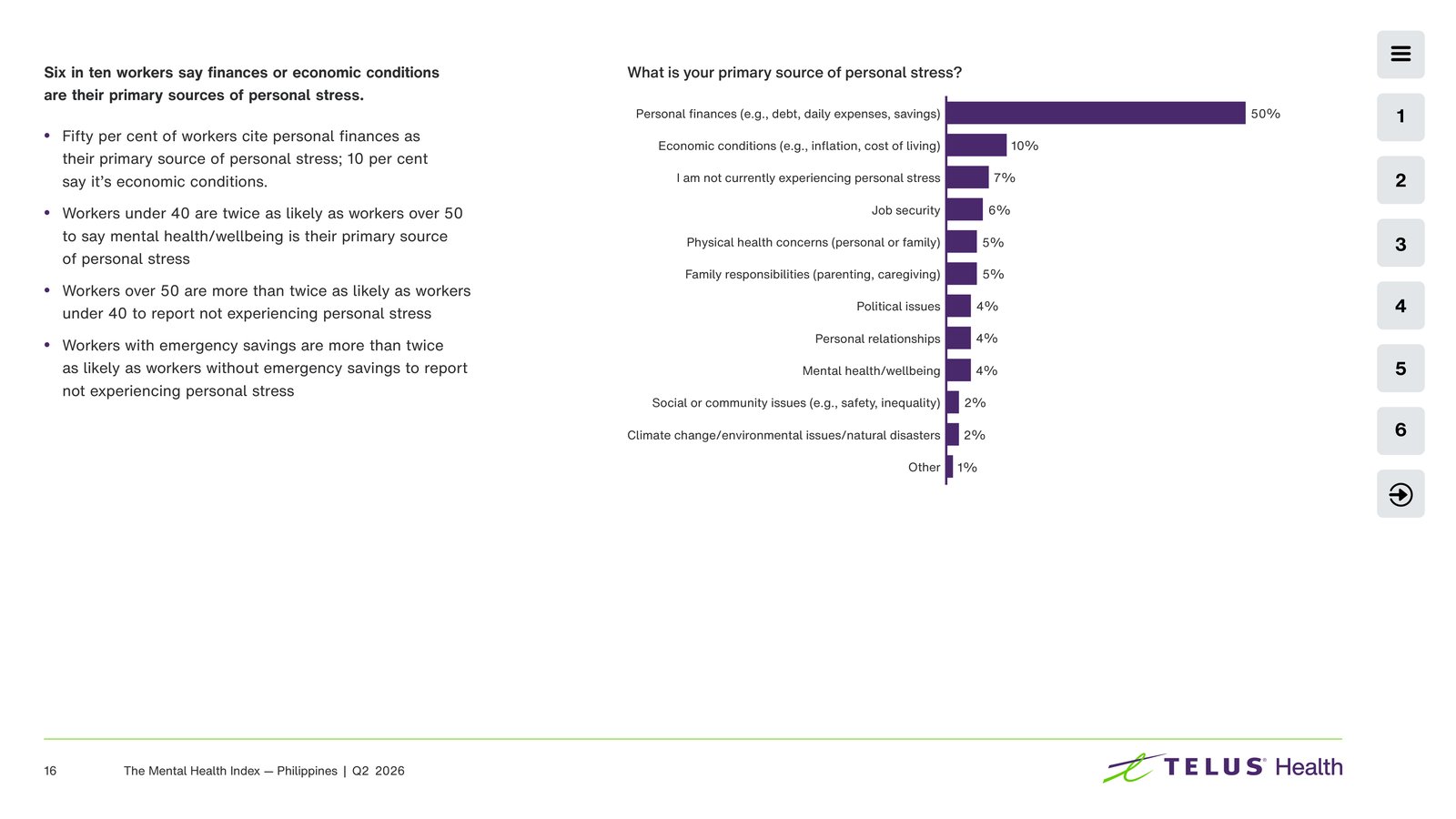
Half of workers name personal finances as their main source of personal stress, and 54 percent lack emergency savings for basic needs. Those citing finances as their main stressor lose an estimated 44.6 working days a year. In addition, workers without emergency savings scored 55.5 out of 100 on mental health, against 69.0 for those with savings.
Paula Allen, Global Leader of Research and Insights at TELUS Health, said daily financial survival and family obligations leave little room for long-term safety nets. As a result, an unforeseen expense can become a mental health crisis.
Younger workers and disasters
- Younger workers: those under 40 were twice as likely as workers over 50 to report constant stress, and 70 percent more likely to end the day exhausted
- Natural disasters: 24 percent lost income from work stoppages, and 14 percent struggled to work remotely because of power or internet outages
- Work stress: high workload led at 21 percent, followed by poor work-life balance at 20 percent and lack of support at 13 percent
Stigma and support gaps
Seventy-seven percent of workers worry that disclosing a mental health issue could limit their careers. Furthermore, 63 percent would feel negatively about themselves if they had one, up from 57 percent in 2022. Jamie MacLennan, Region Head, Asia-Pacific at TELUS Health, said leaders need proper training to address stigma.
Cost was the top barrier to support at 52 percent. Meanwhile, 32 percent did not know which care suited them and 29 percent did not know where to seek help. Only 60 percent of managers said they would know what to do if an employee struggled, and 42 percent of workers said their manager had not shared wellbeing programs.
What employers can take from it
The findings make employee mental health a strategic and commercial priority. Consequently, confidential, accessible support and trained managers may do more for productivity than attendance rules. For more on the research, see the TELUS Health website.


